Song Sift
An app that turns any MP3 on your phone into a backing track: it separates guitar, drums or vocals with AI and hands you a mixer in your pocket.
In 2025 we started exploring what the new generative AI tools opened up for the music world.
Stem separation stood out right away: it speaks directly to what Cifra Club has always done, helping people play, and it had room to become a product of its own.
I took on the challenge of conceiving, structuring and designing the app end to end. It was born as a standalone tool, with international potential even, since it doesn't carry the copyright limitations Cifra Club faces.
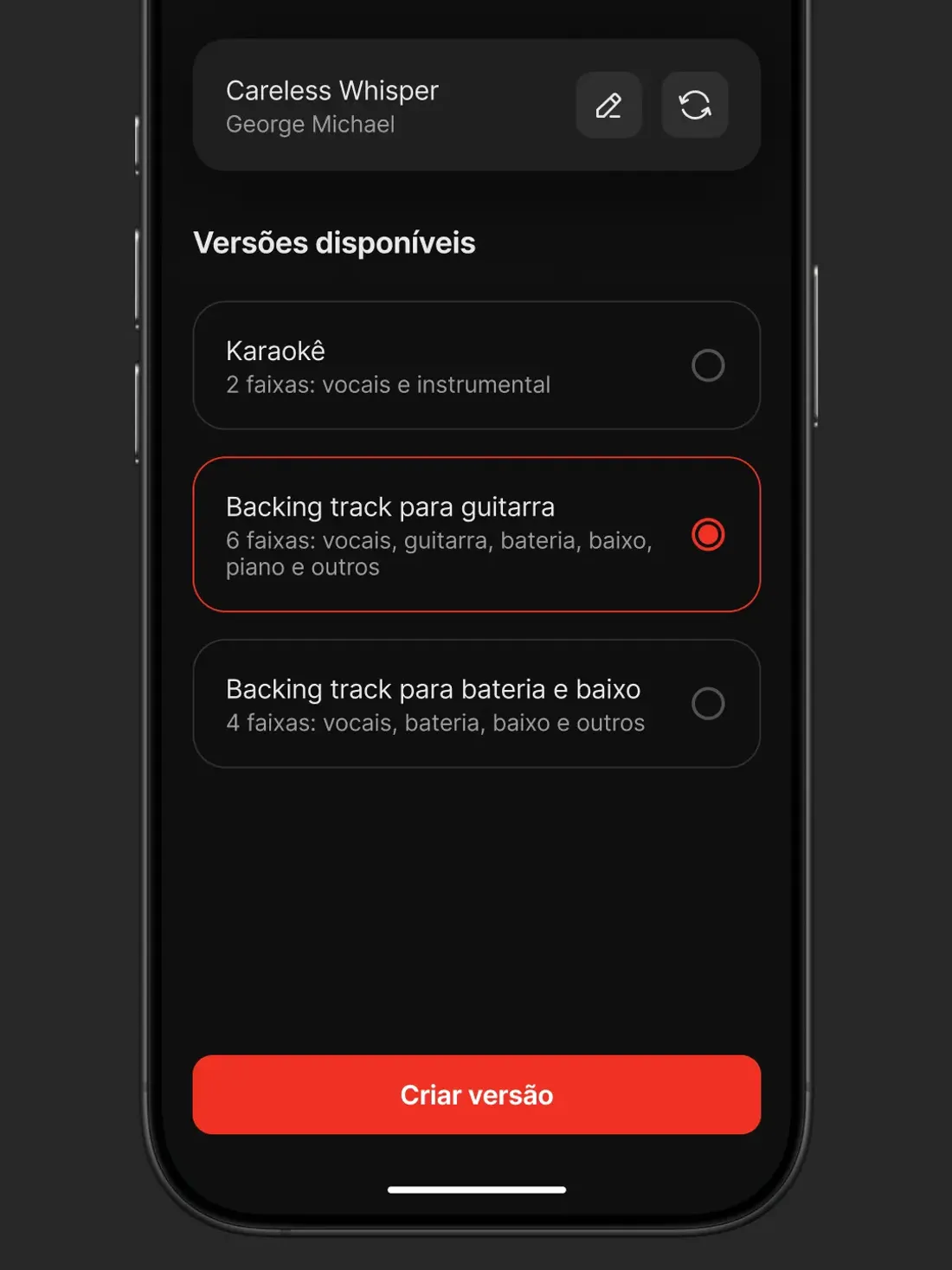
The product had to go beyond the "separate and done" trick:
be a real tool for creating backing tracks.
Separating stems with AI is impressive, but it's an imperfect technology and expensive to process, with a latency the user feels. The challenge was to turn that into a flow people actually use to play, efficient at what it needs to deliver and honest about what the technology can handle.
Before drawing a single screen, I ran a deep dive into the market, the technology we had in hand, and above all the jobs-to-be-done behind creating a backing track and isolating stems.
I wanted to know where the pains lived and where it was worth pushing. I worked side by side with the tech team to map the possibilities and the limits, so the app only promised what it could deliver.
The core is simple to describe: you pick an MP3 you already have on your phone and get back the separated instruments, guitar, drums, vocals.
All the processing is server-side; nothing runs on-device. The app uploads the file and receives the result, preserving format and quality close to the original, and the design had to handle that latency with clear upload and processing states.
From there, I designed the affordances of a real mixer:
- mute and unmute instruments;
- balance the volume of each track;
- save several versions of the same song for different uses.
The app also takes care of the library. Downloaded audio almost always comes with no metadata, so the system fixes the ID3 tag and organizes the files on the device, so the library doesn't turn into a pile of untitled tracks.
For delivery, I used the project to try a new stack. Since there were no platform requirements here to justify going native, unlike Studio Sol's native apps, we went with Flutter: one codebase for both stores, with more development speed and easier maintenance.
At the time I was the team's Design Manager and still ran this project hands-on. Every so often I dove into a project myself, sometimes with the team's support, to stay close to execution and not go rusty while leading. Song Sift was one of those.
The app is live on iOS and Android, in ongoing refinement. In usability tests and with the closed group we invited to use it, the response was strong: it solves the pain we had mapped, from the loose file to a backing track ready to play.
Credits
- Product design
- Josue Macedo
- Branding
- Heron Vieira
Tools
Figma · Flutter